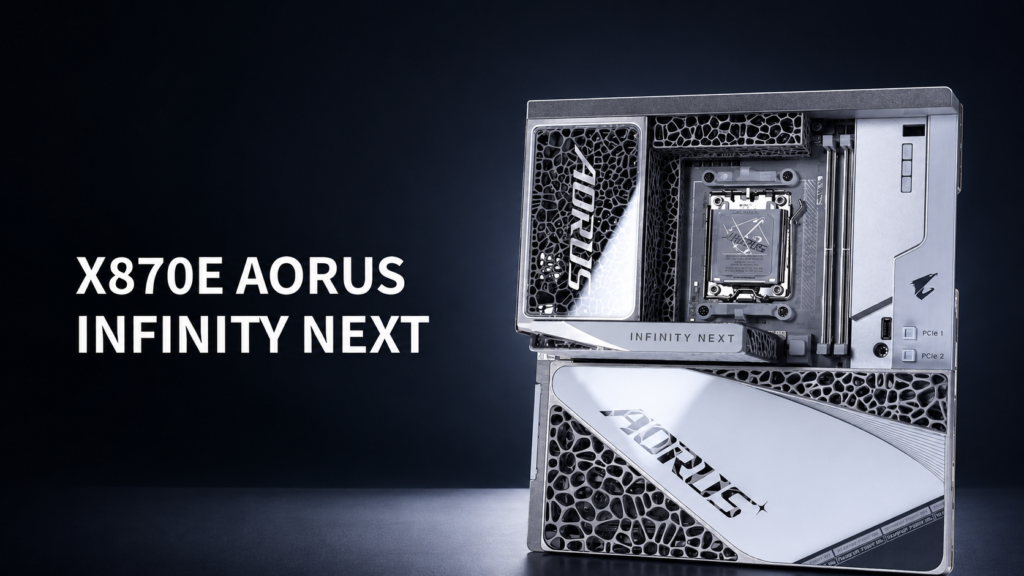

The GIGABYTE X870E Aorus Infinity Next motherboard is GIGABYTE’s statement piece for the AM5 platform. Designed to push the envelope, it aims to deliver uncompromising performance for the most demanding users. This isn’t just another incremental update; it represents the current peak of GIGABYTE’s engineering for consumer motherboards. If your goal is to build a system where every component is optimized for maximum CPU power and thermal efficiency, the GIGABYTE X870E Aorus Infinity Next warrants a serious look.
Key Features of the GIGABYTE X870E Aorus Infinity Next
I feel the gaming market is increasingly going premium, but that’s effectively shutting out new enthusiasts.
Power Delivery: Beyond the Norm
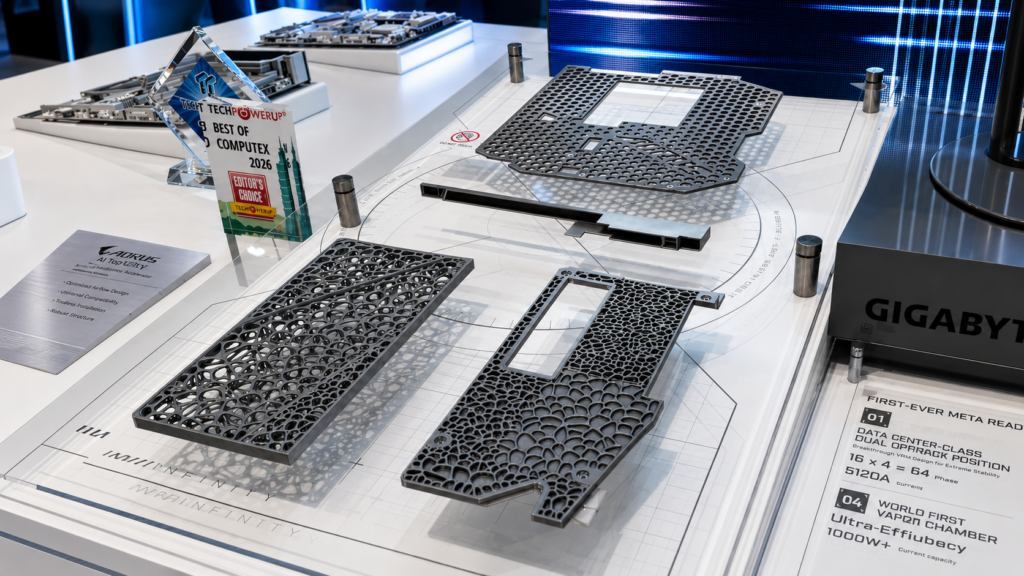
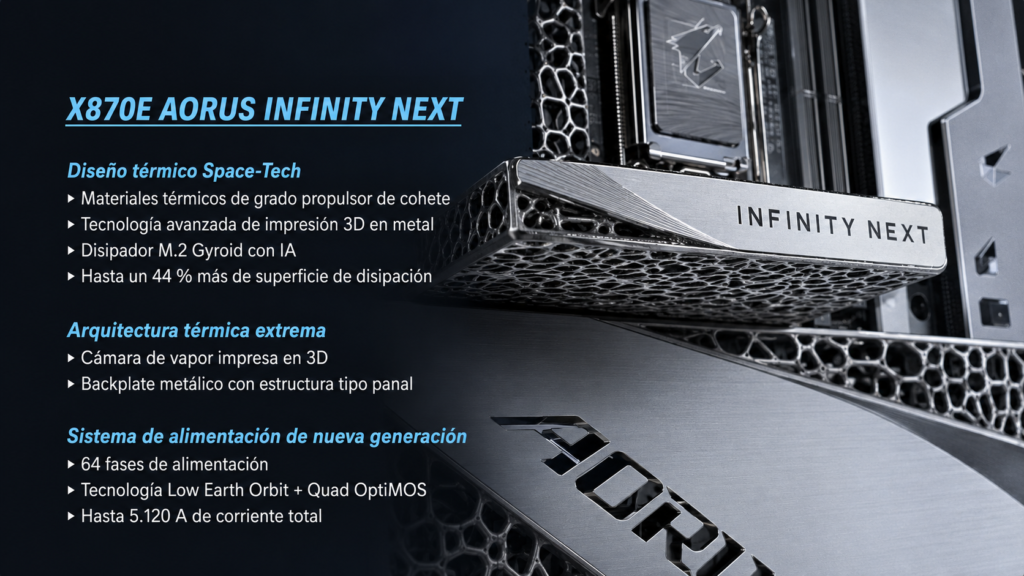
The first specification that grabs attention on the GIGABYTE X870E Aorus Infinity Next is its power delivery system. GIGABYTE has confirmed a staggering 64 power phases, boasting a total current capacity of up to 5,120 amps. Honestly, these numbers are well beyond what most users will ever need for a typical gaming or even heavy content creation rig. This isn’t merely a “high-end” board; it’s engineered for extreme scenarios. We’re talking about configurations designed to extract every last MHz from a processor, maintaining stability under the most punishing, sustained loads without hitting thermal or electrical limits. The catch is, for a standard setup, much of this robust power delivery capacity will remain untapped. But for those aiming for competitive overclocking or running resource-intensive applications for hours on end, this headroom translates directly into stability and potential for higher sustained clocks.
Cooling Innovations: Aerospace Meets PC Hardware
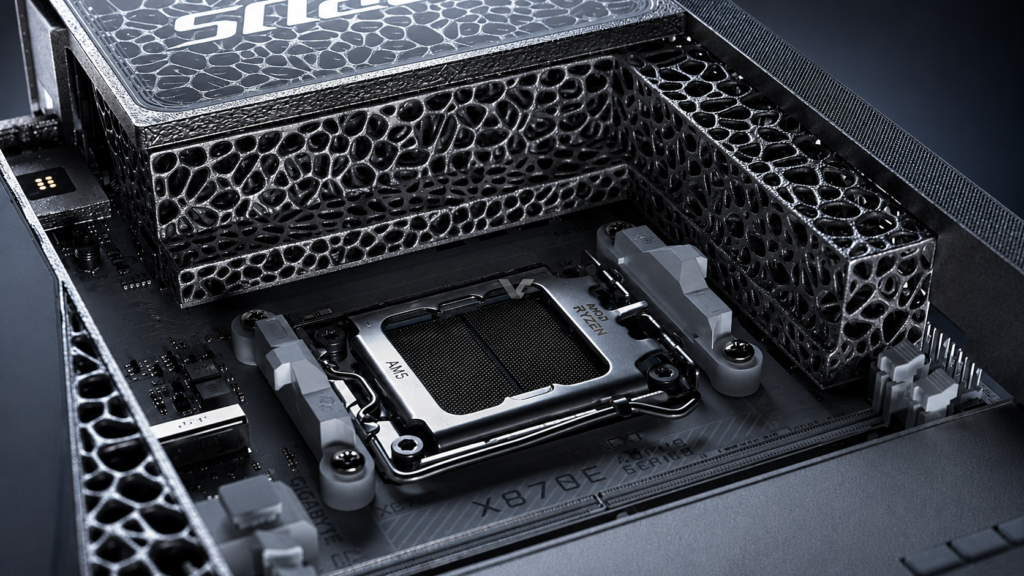
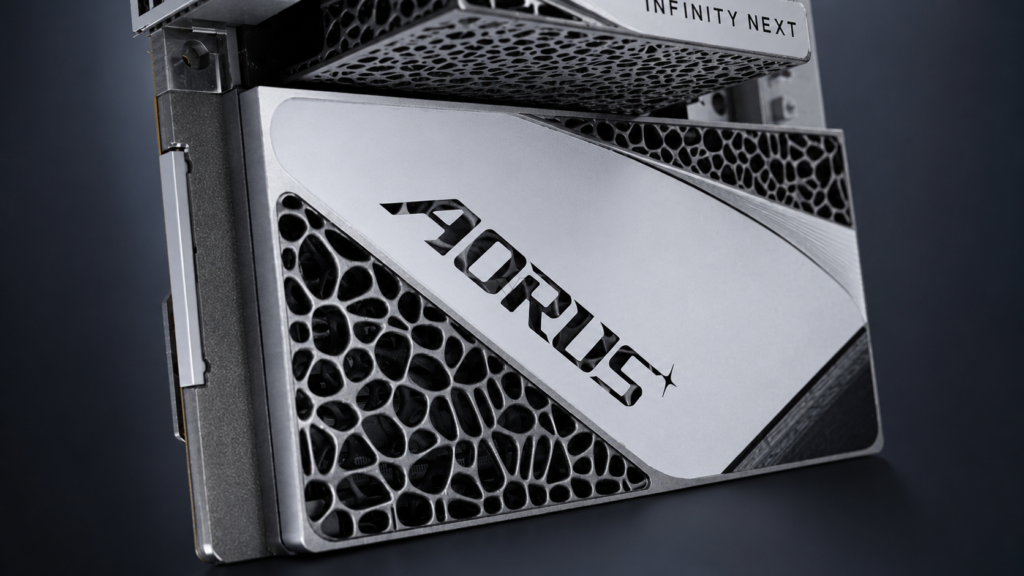
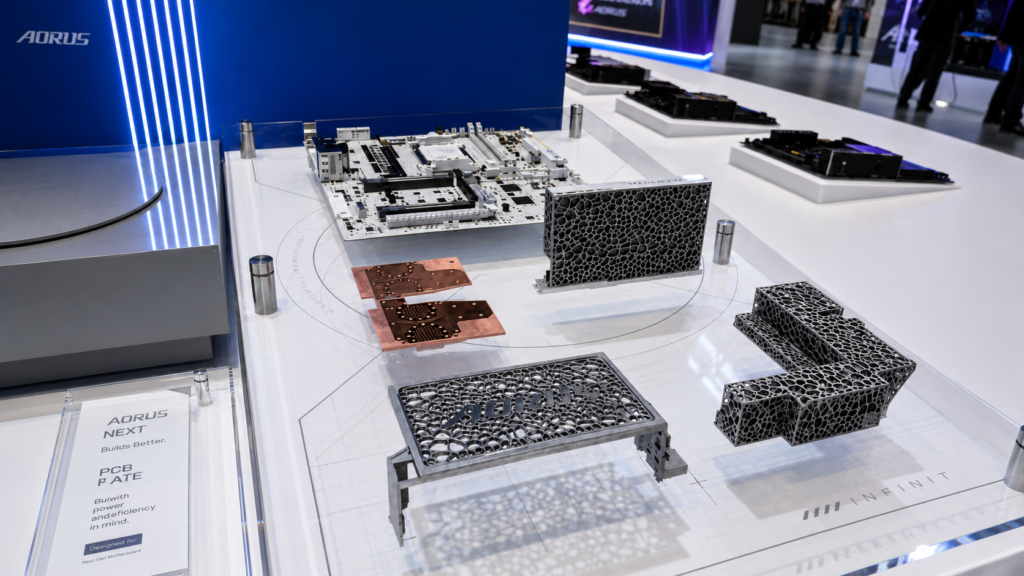
If the power delivery is a significant leap, the GIGABYTE X870E Aorus Infinity Next’s cooling solution is arguably its most distinctive feature. GIGABYTE has integrated thermal materials and design principles inspired by aerospace applications, incorporating several components manufactured using 3D metal printing. This manufacturing technique is still quite novel in the consumer motherboard space.
Look, the standout element here is the M.2 heatsink, which features a Gyroid structure. This isn’t just an aesthetic choice; it’s an organic, complex lattice impossible to produce with traditional machining methods. GIGABYTE reports this design increases the cooling surface area by a substantial 44% compared to conventional flat heatsinks. In practice, this means your high-speed NVMe drives, which can generate considerable heat under load, should run significantly cooler. This directly reduces the risk of thermal throttling during large file transfers, game loading, or intensive data operations, ensuring consistent performance.
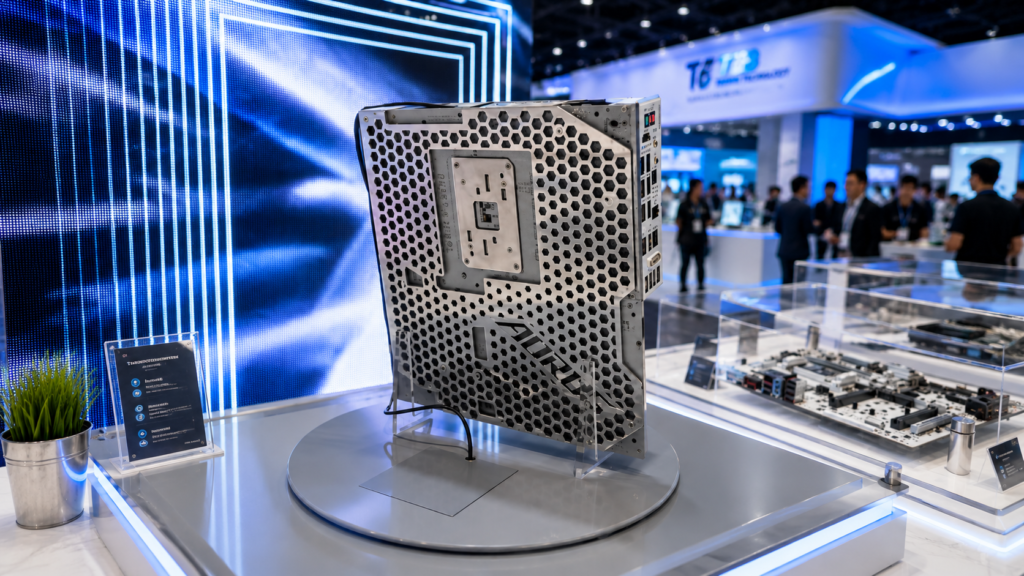
Beyond the Gyroid, the board incorporates a 3D-printed vapor chamber. This advanced cooling component is more efficient at spreading heat across a larger surface area than traditional copper heat pipes, drawing heat away from critical components more effectively. Additionally, the metallic backplate features a honeycomb structure. This isn’t just for enhancing the board’s structural rigidity; it actively contributes to heat dissipation from the underside of the PCB. For me, these cooling measures underscore the board’s primary objective: delivering maximum sustained performance, not just brief peak bursts.
X3D Turbo Mode 2.0: Intelligent Overclocking
The GIGABYTE X870E Aorus Infinity Next also introduces X3D Turbo Mode 2.0, GIGABYTE’s proprietary AI-assisted overclocking technology. This isn’t just a software tweak; the board integrates a dedicated chip designed to monitor system status and workload type in real-time. Whether you’re engaged in a demanding gaming session, rendering complex 3D models, or running scientific simulations, this chip collects data. It then cross-references this information with a dynamic overclocking engine, trained using extensive datasets, to automatically adjust your CPU’s performance.
The core idea is to provide a more intelligent, adaptive overclock. Instead of static settings, the system dynamically optimizes clock speeds and voltages based on the actual demands placed on the hardware. This is particularly relevant for CPUs like the Ryzen 9950 X3D2, which can benefit significantly from precise, real-time adjustments to maintain optimal performance without exceeding thermal or power limits. Your mileage may vary in terms of the raw performance uplift, but the aim is a more stable and efficient overclocking experience, minimizing the need for manual fine-tuning.
Comparative Landscape: A Top-Tier Contender
To truly appreciate the GIGABYTE X870E Aorus Infinity Next, it helps to place it within the context of other flagship motherboards. Let’s consider how its design philosophy stacks up against a high-end Intel platform equivalent, such as an MSI MEG Z890 Godlike.
| Specification | X870E Aorus Infinity Next | High-End Intel Equivalent (e.g., MSI Z890 Godlike) |
|---|---|---|
| Power Phases | 64 phases | Typically around 26+2+1+1 phases |
| Current Capacity | Up to 5,120 A | Often uses 110A Smart Power Stage (SPS) designs |
| Memory (OC speed) | Up to 11,400 MT/s | DDR5 9,200+ MT/s (OC) |
| Highlight Cooling | Gyroid 3D heatsink, 3D vapor chamber, honeycomb backplate | Sophisticated heat pipe arrays, advanced thermal pads, sometimes integrated fan systems |
| Assisted Overclocking | X3D Turbo Mode 2.0 (AI, dedicated chip) | Proprietary OC engines, often paired with diagnostic LCD screens or software suites |
Worth noting that while the sheer phase count on the GIGABYTE X870E Aorus Infinity Next is significantly higher, raw phase count isn’t the sole determinant of power delivery quality; component choice and topology also play a role. That said, 64 phases is an undeniable declaration of extreme capability. Memory speeds are also pushed to impressive theoretical highs, though achieving stable operation at 11,400 MT/s depends heavily on the specific CPU’s integrated memory controller and the quality of your RAM kit. The cooling solutions, with their aerospace-inspired materials and 3D printing, are where the GIGABYTE X870E Aorus Infinity Next truly carves out a unique niche.
Who Is This Board For?
Honestly, this is where a dose of reality is needed. Many of the advanced features packed into the GIGABYTE X870E Aorus Infinity Next — the massive 64-phase power delivery, the innovative Gyroid heatsink, the vapor chamber — are primarily justified if your objective is to push your processor to its absolute maximum. We’re talking aggressive, competitive overclocking, or running extremely demanding, sustained productivity workloads for extended periods.
If your primary use case involves standard gaming, even with a top-tier Ryzen CPU like the 9950 X3D2, you are unlikely to experience a noticeable real-world performance difference compared to a well-designed mid-to-high-end X870 motherboard. The thermal and power delivery overhead offered by the Infinity Next is simply far beyond what typical use cases demand.
Bottom line: The GIGABYTE X870E Aorus Infinity Next is specifically engineered for:
- Serious overclockers and competitive benchmarkers who aim to break performance records.
- Professionals who rely on their systems for sustained, heavy productivity tasks such as complex video rendering, scientific simulations, or large-scale data analysis, where stability under extreme load is paramount.
- Enthusiasts who simply desire the absolute highest-tier hardware available, where cost is not the primary limiting factor and bragging rights matter.
What We Don’t Know Yet
As of now, GIGABYTE has not released official pricing or specific availability dates for the GIGABYTE X870E Aorus Infinity Next. When those details become public, we will update our coverage accordingly. Should we manage to get our hands on this board, you can expect a comprehensive analysis complete with real-world testing and benchmarks, delivered with our usual no-nonsense approach.
FAQ
What is the primary advantage of the GIGABYTE X870E Aorus Infinity Next’s 64 power phases?
The 64 power phases provide exceptional stability and ample headroom for extreme overclocking and sustained, heavy CPU loads. This ensures consistent power delivery even when pushing a processor to its absolute limits, preventing throttling and maximizing performance potential.
How does the Gyroid M.2 heatsink improve cooling?
The Gyroid structure is a complex, organic shape, impossible with traditional manufacturing, that significantly increases the cooling surface area for M.2 SSDs. This enhanced surface area allows for more efficient heat dissipation, helping to keep high-speed NVMe drives cooler and prevent thermal throttling under heavy use.
Is the GIGABYTE X870E Aorus Infinity Next suitable for a standard gaming PC?
While the GIGABYTE X870E Aorus Infinity Next offers top-tier features, much of its extreme engineering, such as the massive power delivery and advanced cooling, provides overhead that is largely unnecessary for standard gaming. A mid-to-high-end X870 board would likely offer comparable real-world gaming performance for a significantly lower cost. This board is overkill for most gamers.